Larson, Steve. The Four Keys to Mental Health: How to Feel Better, Think Clearly, and Enjoy Life Again. Chosen, 2026.
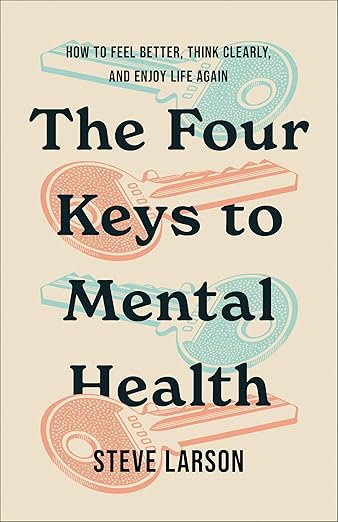
Overall Impression: An accessible read with some good insights that should be approached with caution.
Methods: The author draws on his own experience as both a pastor and someone who personally struggles with mental health. He cites scientific research, Scripture, and faith tradition and provides practical exercises alongside theoretical concepts.
Strengths: The book is written in an accessible manner. The author brings lived experience and empathy that is demonstrable throughout the text. The author provides conceptual insights and practical exercises, with useful summaries at the end of each chapter. The author’s main point, that to address mental health one must focus on spiritual, physical, mental, and relational aspects, is both valid and potent.
Weaknesses: The author’s theological and scriptural understandings reflect a more conservative theological perspective than some readers may be comfortable with. His perspectives on physical health reflect standard diet culture concepts which are problematic at best. His perspectives on mental and relational health lack a detailed examination of systemic and structural factors. His perspectives on spiritual health lack an openness to diverse theological understandings, interfaith perspectives, and a robust understanding of spirituality, instead prioritizing a relatively narrow interpretation of Christianity as the key to true spiritual health.
Recommendations: This book should not be read treated as the sole resource for mental, physical, spiritual, and relational health. It should either be read in combination with other works that specialize in that area and/or by a reader who already has some knowledge of the concepts covered so they can identify and adopt what is useful, but reject what is problematic or even dangerous.


Thanks for the review. Is there a text that you would recommend that takes a more open view of spiritual/physical health around body image?
LikeLike
Hi Allie! Good question!
I actually find a paucity of texts that I would recommend in this regard. There are a few that have been attempted, and a few that are in my “to-read” pile, but a text that does a robust job of combining health across dimensions with faith/spirituality is difficult to find. That said, I have a few suggestions:
The Wisdom of Your Body: Finding Healing, Wholeness, and Connection through Embodied Living by Hilary L. McBride is probably the first one I’d recommend. She is Christian herself but the book is written from her practice as a psychologist so is not explicitly faith-influenced. However, it is a relatively accessible read, provides practical exercises for embodied skills, and a broadly spiritual dimension is present.
Explicitly Christian resources to explore include:
I Love Jesus, But I Want to Die: Finding Hope in the Darkness of Depression by Sarah J. Robinson is an accessible read combining Christian faith and mental health in memoir format.
Learning to Walk in the Dark: Because Sometimes God Shows up at Night by Barbara Brown Taylor is an accessible read combining Christian faith and explorations of darkness and night which includes mental/spiritual darkness.
Miracles and Other Reasonable Things: A Story of Unlearning and Relearning God by Sarah Bessey is an accessible read that combines Christian faith with explorations physical and mental health in memoir format.
Surviving God: A New Vision of God Through the Eyes of Sexual Abuse Survivors by Grace Ji-Sun Kim and Susan M. Shaw is a more advanced read that applies their intersectional theology paradigm to explore both times when the church has been unhealthy and ways in which healthy communities may be developed.
Texts to explore that are not explicitly theological/spiritual but are concerned with health and wellness in robust ways:
Embodied Activism: Engaging the Body to Cultivate Liberation, Justice, and Authentic Connection-A Practical Guide for Transformative Social Change by Rae Johnson is a more advanced read. It is not explicitly theological/spiritual but provides a highly compelling exploration of the importance of cultivating embodied skills and practical ways to improve such skills.
The Wellness Trap: Break Free from Diet Culture, Disinformation, and Dubious Diagnoses, and Find Your True Well-Being by Christy Harrison is an accessible read. It is not explicitly theological/spiritual but is a good guide to avoiding some of the spiritual bypassing that can arise in health/wellness spaces and practices.
Hope that helps! 🙂
LikeLike